How much does a website cost?’ is one of the most Googled questions by small business
owners — and one of the most confusing to answer. Quotes range from £200 to £200,000
depending on who you ask. In this guide, we break down exactly what a business website costs
in 2026 across the USA and UK, what drives those costs, and how to make sure you spend
your budget wisely.
Whether you need a simple 5-page brochure site or a fully custom web application, this guide
gives you real numbers — not vague ranges.
Why Website Costs Vary So Much?
- Complexity: A 5-page brochure site is very different from a 50-page e-commerce store with
custom filtering.
- Who builds it: A freelancer, template service, or full-service agency all price and deliver very
differently.
- Design: Custom-designed from scratch vs. adapting a premium template. Custom costs
more but converts better.
- Functionality: Contact forms, booking systems, e-commerce, membership areas, CRM
integrations — each adds cost
- Content: Some agencies include copywriting; others don’t. Professional copy adds cost but
significantly improves SEO and conversions.
- Ongoing support: A one-off build vs. a monthly retainer with updates, hosting, and
maintenance.
Business Website Cost Breakdown — 2026
Tier 1: Starter Website — $999–$1,499 (USA) / £800–£1,200 (UK)
Best for: New businesses, sole traders, local service businesses, and anyone who needs a
credible online presence quickly.
- 5–6 pages: Home, About, Services, Contact, Blog
- Premium WordPress or Shopify theme, customised to your brand
- Responsive design — works on mobile, tablet, and desktop
- Basic on-page SEO setup and speed optimisation
- Contact form, Google Maps integration, security setup
- Launch-ready in 2–3 weeks
Tier 2: Growth Website — $1,499–$3,500 (USA) / £1,200–£2,800 (UK)
Best for: Growing businesses that need stronger SEO, better conversion architecture, and more
pages.
- Up to 15 pages with custom layouts and advanced responsive design
- Advanced on-page and technical SEO built in from the start
- Lead generation forms, live chat integration, analytics setup
- Blog with category structure and SEO architecture
- Launch-ready in 3–5 weeks
Tier 3: Custom Website or Web Application — $3,500–$25,000+ (USA) / £3,000–£20,000+ (UK)
Best for: Businesses with complex requirements — e-commerce, booking systems, membership
platforms, client portals, or custom software needs.
- Fully custom designed and developed — no templates
- Complex functionality: e-commerce, subscriptions, user accounts, CRM integrations
- API integrations with third-party systems
- Timeline: 6–16 weeks depending on scope
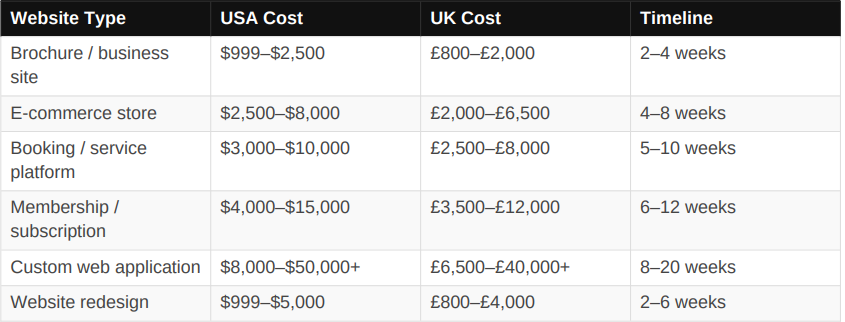
Website Cost by Type
Website Cost by Type
- Domain name: $10–$20/year. Usually not included in the build cost.
- Web hosting: $5–$50/month. Cheap hosting = slow website. Budget at least $20/month for
managed WordPress hosting.
- SSL certificate: Should be free (Let’s Encrypt). Any agency charging for SSL in 2026 is
overcharging.
- Stock photography: $2–$15 per photo. Budget $50–$200 for a quality image library.
- Copywriting: Professional website copy adds $500–$2,000 but dramatically improves SEO
and conversions.
- Ongoing maintenance: Security updates, backups, plugin updates. Budget
$50–$200/month.
How to Get the Best Value Without Compromising Quality
- Don’t choose on price alone. A $300 website from a freelancer and a $1,500 website from a
professional agency are completely different products
- Ask to see live examples. Any agency worth hiring has a portfolio of live, working websites.
Click through them on mobile.
- Check their SEO knowledge. A beautiful website that doesn’t rank on Google is decoration,
not a business tool.
- Understand what happens after launch. Who updates the plugins? Who fixes it if it breaks?
Get this in writing.
- Request a phased approach. A well-built starter site is far better than a cheap ‘all-in-one’
you’ll replace in a year.
Frequently Asked Questions
Ready to save 20 hours a week?
Relicsol builds custom AI automation systems for businesses in the USA, UK, and Europe.
Book a free 30-minute consultation and we’ll identify the top 3 automations that would save
you the most time.